The ladder of abstractions
Note: the arrows are the links.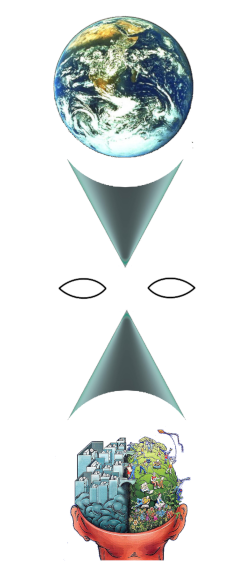 The "ladder of
abstractions" or "abstraction ladder" is a concept taken from the field of
general semantics
The "ladder of
abstractions" or "abstraction ladder" is a concept taken from the field of
general semantics
 , founded by Alfred Korzybski
, that has as its basis
the fact that what we have in our heads is not the real world, but a model
of the world, for which goes: "The map is not the territory"
- see the illustration at the right.
Korzybski build a model of this called the "structural differential"
,
which became best known by the later version by S.I. Hayakawa
, in his book Language in Thought and Action
as the abstraction ladder. Here we combine both versions with modern
knowledge of neurology into what is hoped to be a more complete one.
, founded by Alfred Korzybski
, that has as its basis
the fact that what we have in our heads is not the real world, but a model
of the world, for which goes: "The map is not the territory"
- see the illustration at the right.
Korzybski build a model of this called the "structural differential"
,
which became best known by the later version by S.I. Hayakawa
, in his book Language in Thought and Action
as the abstraction ladder. Here we combine both versions with modern
knowledge of neurology into what is hoped to be a more complete one.The process of making the model inside the head is executed mostly unconsciously, by our sensory organs and the large number of neurological structures attached to them. The evolutional drive behind developing this system starts with that it is advantageous to be able to distinguish between preditory life forms and friendly or indifferent ones, i.e. to be able to collect these into separate and distinguishable groups. These groups aren't objects existing in the real world, thus creating a distinction between objects in the model that are and those that aren't part of the real world, the "abstractions" - the bluish cubicles in the first illustration.
This capacity is present in many species, amongst whom certainly those that are able to warn each other for danger. It is developed the farthest in humankind, in a form known as "speech". Which has led to more kinds of abstractions, known as "higher abstractions".
The abstraction ladder is an attempt to a systematic approach to the relations between the kinds of groups of all sorts, including the "abstractions", when these are expressed in words. This is the analogue in speech or language of the neurological processes taking place in the brain when distinguishing between species. This description starts by analyzing the different kinds of words.
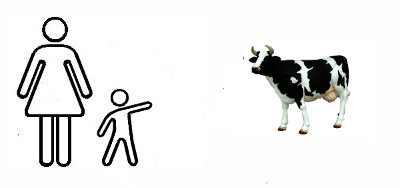 The first kind of word and also a prime candidate to be the
origin of the development of speech are here called "object words" - words
that denotes things that you can point to in the real world. They are an
necessity in order to be able to make a connection between a specific utterance of
sounds coming out of your mouth and the objects in de the real world. Even
"modern" kids start to learn language this way, for the example in the
illustration: Mama: "There is Bessie!".
The first kind of word and also a prime candidate to be the
origin of the development of speech are here called "object words" - words
that denotes things that you can point to in the real world. They are an
necessity in order to be able to make a connection between a specific utterance of
sounds coming out of your mouth and the objects in de the real world. Even
"modern" kids start to learn language this way, for the example in the
illustration: Mama: "There is Bessie!". 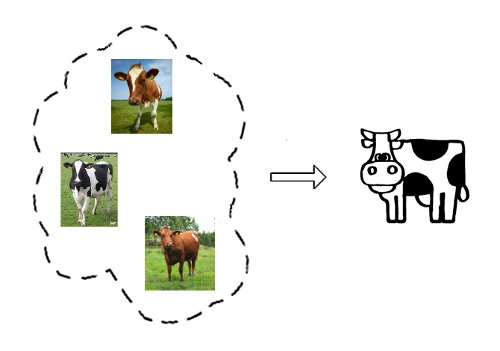 The second kind of words are those of the
natural collections of these objects, in this case: all of the objects that
look like "Bessie": "Clare", "Mathilda" etc., where "Clare" and "Mathilda"
are the "object words" connected to two other "cows" that occupy the meadow
of the farm, where "cows" is the word for the collection of traits that
these three (and probably more) have in common. Whereby also a lot of the
individual traits of Bessie etc. have been lost. The fact that a lot of traits are lost while retaining certain others, is denoted by the
other word for this collection: "abstraction".
The second kind of words are those of the
natural collections of these objects, in this case: all of the objects that
look like "Bessie": "Clare", "Mathilda" etc., where "Clare" and "Mathilda"
are the "object words" connected to two other "cows" that occupy the meadow
of the farm, where "cows" is the word for the collection of traits that
these three (and probably more) have in common. Whereby also a lot of the
individual traits of Bessie etc. have been lost. The fact that a lot of traits are lost while retaining certain others, is denoted by the
other word for this collection: "abstraction". 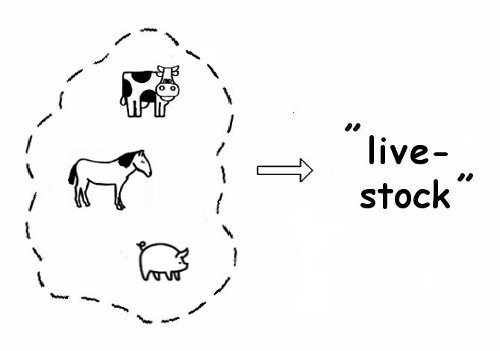 Tom's farm is also the residence of other objects besides "cows".
"Horses" and "pigs" are quite different from "cows", but to farmer Tom they
also have similarities: they all require feed, they all produce manure,
etc. These common traits are abbreviated into the word "livestock", which
can also be seen as a "collection of collections". Note there is in general no
natural way to associate a symbol with these "collections of collections"
.
Thereby one can distinguish them from the first kind of collections, which
were equivalently named "abstractions", as "higher order abstractions".
Tom's farm is also the residence of other objects besides "cows".
"Horses" and "pigs" are quite different from "cows", but to farmer Tom they
also have similarities: they all require feed, they all produce manure,
etc. These common traits are abbreviated into the word "livestock", which
can also be seen as a "collection of collections". Note there is in general no
natural way to associate a symbol with these "collections of collections"
.
Thereby one can distinguish them from the first kind of collections, which
were equivalently named "abstractions", as "higher order abstractions". As part of the collection of "livestock", Bessie loses even more of her specific traits: giving milk (at least: as a mass-producer), and also for example her color: cows are frequently black-and-white, horses are brown and pigs are pink. So note: one cannot have "the color of livestock".
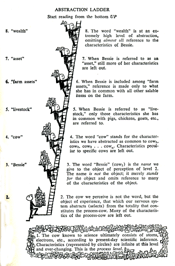 It should be clear that this last addition to the kinds of words opens the
floodgates. For example: one can combine farmer Tom's "live stock" with all
of the machinery he needs for his work into "farm assets". Possible further
steps are "property", and "wealth" or "capital". Those are the steps used by
the originator of this version of "the ladder of abstractions", S.I.
Hayakawa
, in his book Language in Thought and Action
(click on the illustration for a larger version).
It should be clear that this last addition to the kinds of words opens the
floodgates. For example: one can combine farmer Tom's "live stock" with all
of the machinery he needs for his work into "farm assets". Possible further
steps are "property", and "wealth" or "capital". Those are the steps used by
the originator of this version of "the ladder of abstractions", S.I.
Hayakawa
, in his book Language in Thought and Action
(click on the illustration for a larger version).But other classifications are equally possible: farmer Tom's property is part of the agricultural assets of the village, the village is an element of the region, the regions make up the country, etc. So not only are the floodgates opened as far as the depth of the abstractions is concerned, but this also applies to their width. In fact, the possibilities of making abstractions never end - the universe is probably big enough for all of them. But this limitation never comes into sight, because where it is possible to have any number of them, most of them have little or no practical use: one can take cows together with peeling knives, but it hardly seems to make any sense (of course: creative types will have a go after such a statement).
This is the model as developed in the field of general semantics. It is now going to be extended with some new features. First of all the abstraction ladder is generalized, and this generalization leads the way to what was also an ultimate goal of Korzybski: the connection with neurology and psychology.
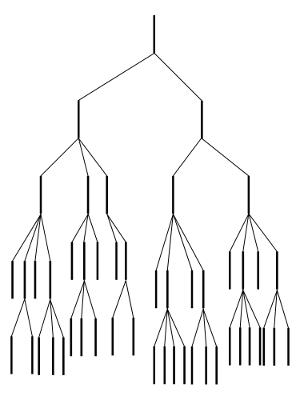 The
first step is to turn Hayakawa's example into a more general and extensible
scheme, the
figure on the right. When going back to Hayakawa's specific example, the "Bessies" and other cows and horses and tractors
would be on the bottom, and the most abstract concept, "money" or "wealth", on top.
The
first step is to turn Hayakawa's example into a more general and extensible
scheme, the
figure on the right. When going back to Hayakawa's specific example, the "Bessies" and other cows and horses and tractors
would be on the bottom, and the most abstract concept, "money" or "wealth", on top.
However, this orientation conflicts with that of the first illustration, where reality, signified by the earth, is located on the top of the picture and the abstractions, the cubicles on the left side of the brain, on the bottom. And this latter orientation seems to be the more intuitive.
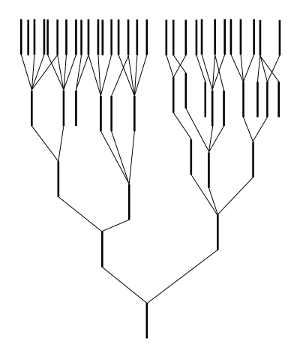 So
lets inverse the orientation of the general scheme, see the next illustration on the
right. This orientation also
corresponds to the intuitive notion of the abstraction scheme as a kind of
filter or sieve, sorting reality while dropping down. One recognizes
"Bessie!" by her "looks", then immediately realizes it is "a cow", after some
time may associate with "the farm", etcetera.
So
lets inverse the orientation of the general scheme, see the next illustration on the
right. This orientation also
corresponds to the intuitive notion of the abstraction scheme as a kind of
filter or sieve, sorting reality while dropping down. One recognizes
"Bessie!" by her "looks", then immediately realizes it is "a cow", after some
time may associate with "the farm", etcetera. Turning back to the first illustration, it is immediately clear that the schemes so far are over there represented by the pair of eyes in the middle - the state of the brain depicted at the bottom is the result.
At which point the first step towards neurology can be taken.
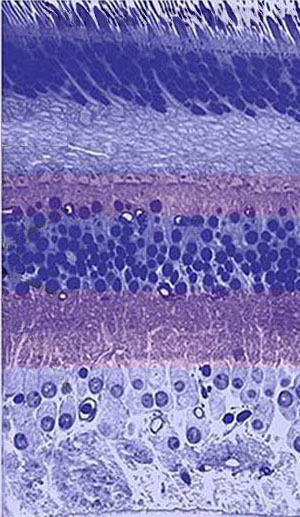 Because this
relation is factual in the sense that the eyes,
the primary sense organs of the human, immediately start making
abstractions, by filtering what it gets as a pattern of points of light into
contours, area's, etcetera. This is done in or by the retina. The retina,
see the anatomical picture on the right, is
a neural network: layers of neurons (darker) with layers of connections in between
- this being a
relatively simple one having three neuron-layers.
Because this
relation is factual in the sense that the eyes,
the primary sense organs of the human, immediately start making
abstractions, by filtering what it gets as a pattern of points of light into
contours, area's, etcetera. This is done in or by the retina. The retina,
see the anatomical picture on the right, is
a neural network: layers of neurons (darker) with layers of connections in between
- this being a
relatively simple one having three neuron-layers. Its output signals are transmitted via the nerves of the eye towards an upper part of the brainstem, where more information is worked into it (e.g. the orientation of the head), and then reassembled for interpretation in the cortex. Which processe already involve all kinds of interpretation with for example movement-signals going faster than stationary ones and subsequently getting processed faster.
This applies to both halves of the brain as depicted in the first illustration, so the next questions are: is the depicted divide real, where does in take place, and why is it there?
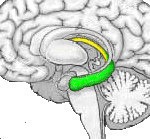 The
fact that it is real is something known (or could have been known) for quite
some decades, through the famous though sad case of "patient H.M."
, someone who had such a bad case of epilepsy that one decided to remove
both of the hippocampi of his brain, the green part in the figure on the
right. The result was that he lost the capacity to form new
articulated memory, the one
associated with spoken things, but not his previous memories nor the memories
necessary for the common things in life - say cooking etcetera. And even
retained the ability to learn new common things. He didn't remember meeting
someone after a minute or so had passed, but he still remembered things like how to go to
the bathroom when the urge arrived.
The
fact that it is real is something known (or could have been known) for quite
some decades, through the famous though sad case of "patient H.M."
, someone who had such a bad case of epilepsy that one decided to remove
both of the hippocampi of his brain, the green part in the figure on the
right. The result was that he lost the capacity to form new
articulated memory, the one
associated with spoken things, but not his previous memories nor the memories
necessary for the common things in life - say cooking etcetera. And even
retained the ability to learn new common things. He didn't remember meeting
someone after a minute or so had passed, but he still remembered things like how to go to
the bathroom when the urge arrived.So things neurology learned are that there are (at least) two kinds of memory: that most associated with language ("declarative memory") and that associated with common life ("procedural memory"). And that associated with language or articulated knowledge is formed in a process where the hippocampus has an essential role.
So there is the prove of the existence of the depicted divide. And the question of "Where?" turns into two questions: "Where the cubicles and where the meadow?"
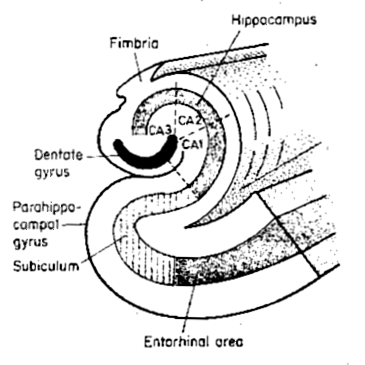 The first of these is the
more easy. It is clear that the hippocampus plays an essential role in
forming declarative or more abstract memory. More recent research
,(a follow-up to the well-known Jennifer Aniston-neuron research)
indicates strongly that the hippocampus is indeed the location where the
abstractions are made. As the previous figure shows, it is located between the centrally
laying structures that control the emotions, usually called the "limbic
system", and the cortex,
the large outer layers of the brain. The cross-section shown above and right
shows the hippocampus and a number of
associated structures lead from this central area towards the neocortex, the big outer
part of the cortex (at the side of the head - not shown in the previous
figure in order to show the inner central parts).
The first of these is the
more easy. It is clear that the hippocampus plays an essential role in
forming declarative or more abstract memory. More recent research
,(a follow-up to the well-known Jennifer Aniston-neuron research)
indicates strongly that the hippocampus is indeed the location where the
abstractions are made. As the previous figure shows, it is located between the centrally
laying structures that control the emotions, usually called the "limbic
system", and the cortex,
the large outer layers of the brain. The cross-section shown above and right
shows the hippocampus and a number of
associated structures lead from this central area towards the neocortex, the big outer
part of the cortex (at the side of the head - not shown in the previous
figure in order to show the inner central parts).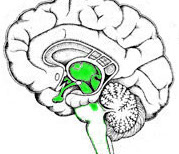 The
other question, "Where is the meadow?" doesn't have a standard answer in
neurology, but a more general systems analysis
The
other question, "Where is the meadow?" doesn't have a standard answer in
neurology, but a more general systems analysis
 shows that in all probability that takes
place in what is known as the "basal ganglia", a number of structures
between the brainstem and the emotion organs (amygdala, nucleus accumbens
etcetera), in the center of the brain.
shows that in all probability that takes
place in what is known as the "basal ganglia", a number of structures
between the brainstem and the emotion organs (amygdala, nucleus accumbens
etcetera), in the center of the brain.So these are preliminary answers to the "Where's?". Now the "How's?", while focussing on the one associated with the abstraction ladder: the declarative or more cognitive half associated with the hippocampus. Like the retina, this in fact is a neural network: lots of neurons organized in layers with layers of connections in between. The hippocampus these layers are curled as in the picture, giving it the resemblance to the shape of a seahorse. Overall it has a much more complicated structure than the retina, and involves several others structures (subiculum, dentate gyrus, etcetera). There is really not much doubt, after the aforementioned research, that these structures perform the actions depicted by the abstraction ladder.
The "How?" situation as far as the "meadow"-like or procedural part of the brain is much less clear, but what is clear that both of these processes have one thing in common: they have to be learned! Just watch a child grow up from a helpless baby.
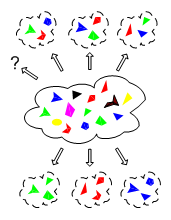 This
situation can also be modelled. In his illustrative version of the abstraction
ladder
, Hayakawa uses geometrical figures to denote different elements
of reality - a common step. What it doesn't show, is that the elements of
reality are upwardly organized in groups with common traits. This is done in
the model illustrated on the right, which is also a link to a larger
interactive version.
This
situation can also be modelled. In his illustrative version of the abstraction
ladder
, Hayakawa uses geometrical figures to denote different elements
of reality - a common step. What it doesn't show, is that the elements of
reality are upwardly organized in groups with common traits. This is done in
the model illustrated on the right, which is also a link to a larger
interactive version. Which immediately introduces an aspect that is not easy to incorporate into natural models: even the first kind of collections are not an obvious choice. And it also illustrates that this choice matters: taking color as an ordering criterion, ends the process immediately. So besides that the making collections or abstractions is a crucial step, the choice of which kind of collections i.e. the choice of criteria is equally vital. It should be clear that the higher the abstractions that can be build, the more able they will be to see higher patterns in the environment and thereby to predict future events, leading to better survivability. And since nature is variable, these criteria should not be build in, but to be learned.
So here is already the answer to the third questions, the "Why's?". The answer: better survivability.
Back to the "How's?" How does one learn?
There are probably several aspects to this, but one of these is the following procedure: "Repeat what does work, and avoid that what doesn't". Now everybody with the slightest knowledge of neurology knows what the brain does to stimulate the repeating of behaviour: it releases dopamine. There are good arguments for the statement that every kind of addiction is in fact an addiction to dopamine.
So if something has been seen to be working: "Eating red berries gives more sugar or more energy, so more dopamine", the next time something similar seems possible, it is associated with the release of dopamine, so this gets to be the preferred choice.
With something similar the other way around, say for poisonous berries. Oddly: this is usually forgotten, so that its associated neurotransmitter isn't known as such, but in all probability (deduced from location of source, etcetera), this is acetylcholine.
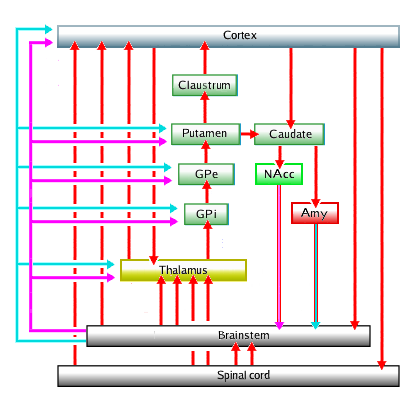 As
stated, this applies to both halves of the big divide in the brain, and in
this case it is the meadowy part that is the more easy one, probably due
tot the fact that its (sub)structures are anatomically better discernible.
These substructures are shown on the right (GP is globus pallidus, internal and
external; Amy is amygdala; NAcc is nucleus accumbens), with the information
(or control) flow denoted by red arrows, and the modulating signals of
dopamine and acetylcholine in magenta and cyan. Note that both dopamine
and acetylecholine are in fact synthesized in the brainstem, making their
association with "emotions" also valid for, say, crocodiles, because these
creatures already have similar structures and neurotransmitters. Or put into
technical terms: dopamine, its cousins and their associated emotions are
probably no more than "feedback signals".
As
stated, this applies to both halves of the big divide in the brain, and in
this case it is the meadowy part that is the more easy one, probably due
tot the fact that its (sub)structures are anatomically better discernible.
These substructures are shown on the right (GP is globus pallidus, internal and
external; Amy is amygdala; NAcc is nucleus accumbens), with the information
(or control) flow denoted by red arrows, and the modulating signals of
dopamine and acetylcholine in magenta and cyan. Note that both dopamine
and acetylecholine are in fact synthesized in the brainstem, making their
association with "emotions" also valid for, say, crocodiles, because these
creatures already have similar structures and neurotransmitters. Or put into
technical terms: dopamine, its cousins and their associated emotions are
probably no more than "feedback signals". At which point we again can take the route back to the first illustration, and the original version of "open skull"-brain (after editing towards reality):
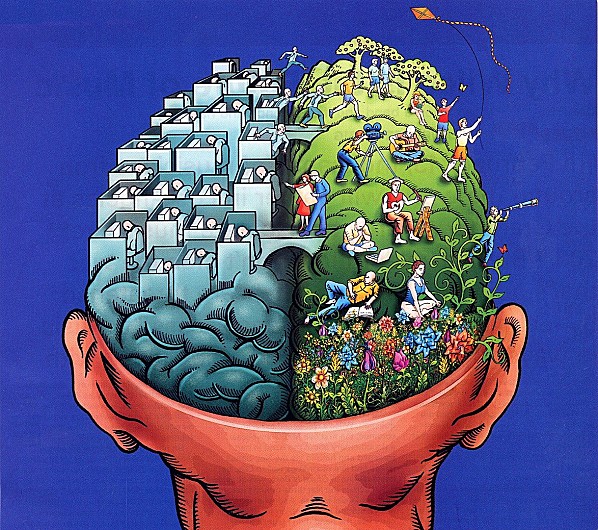 |
At the time of first encounter, it went unnoticed that in this depiction, very fruitful thus far in its illustration of the divide, the general character of the separate halves and the abstractness of the part that deals in concepts or abstractions, that one aspect was missing: the organization of the abstractions. As learned from the abstraction ladder, getting further away from reality they get more abstract and there are less of them. In a working i.e. grown-up brain. In fact: making the present illustration more look like the totally untrained brain of a baby.
So with all extra knowledge gained, it is possible to further enhance the illustration to this:
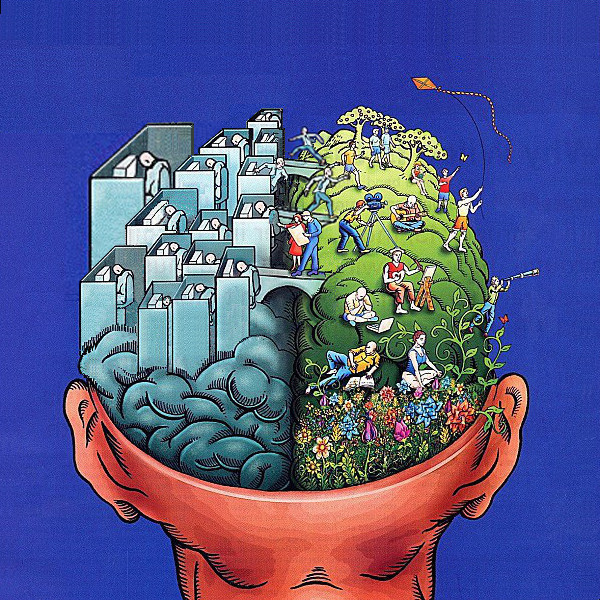 |
As a first step, to denote the extra predictive value of using abstractions, the left hemisphere has been lifted slightly, going further upwards to the left. With the cubicles getting bigger, more sparse and more elevated going further away from reality.
So as an intermediate conclusion it may be noted that some steps have been taken in the direction of Korzybski's original intention: to base language and abstract thinking on neurological processes.
At the same time Hayakawa's basic and more popular model has been extended considerable, making it more similar to Korzybski's, though also taking it away from the didactic virtue of simplicity.
But now we turn direction, towards the another major point Hayakawa and Korzybski shared: the wish to develop better descriptions of the workings of language in order to improve "la condition humaine" - "the enhancement of civilization".
Unfortunately, parts of these problems have already been build into the model presented thus far. Problems of which a major one already has been mentioned, and can be abbreviated into a single term: dopamine. As already stated: there are good arguments for the statement: "All addictions are in fact addictions to dopamine". There are equally good arguments for the reverse: every process that involves dopamine, is subjected to the potentiality of addiction.
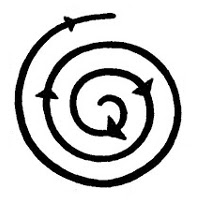
 In
fact, there probably is just one thing extra required to cause the
addiction: a process of feedback
- of the positive kind, that is. Any
feedback-process is a circular process, and the combination of positive
feedback and a circular process leads to unlimited amplification and/or even
faster running circles, due to the mechanical analogue usually portrayed
as an inward spiralling circle.
In
fact, there probably is just one thing extra required to cause the
addiction: a process of feedback
- of the positive kind, that is. Any
feedback-process is a circular process, and the combination of positive
feedback and a circular process leads to unlimited amplification and/or even
faster running circles, due to the mechanical analogue usually portrayed
as an inward spiralling circle.The potentiality also applies to the case of abstractions: to find higher order abstractions (making it possible to make higher order patterns in reality, making it more possible to adapt to future events, giving a better survival rate) nature rewards the individual that does with a dose of dopamine. And of course the higher the abstraction found, the more dopamine.
The next thing to look for is feedback. This has already been introduced implicitly by the combination of two concepts: "learning from reality" and "filtering from reality". Most basically the abstract concepts are learned from reality, and then these abstracts are used to filter reality in order to recognize previously learned patterns - as in the earlier example: "Eating red berries gives more sugar or more energy, so more dopamine". Or in another one: "If it has wings and an aureole above its head, then it's an angel and angels are pretty, so more dopamine".
But now the individual tells of his seeing of something with wings and an aureole, and he also gets the admiration of the people around him. That leads to extra dopamine. Making it more likely that the individual will see things with wings and an aureole again. Or that other people will.
Etcetera.
This also applies to the finding of abstractions. The finding of abstractions releases dopamine. The admiration of others for you doing so, releases extra dopamine.
Etcetera.
Hayakawa devotes a considerable part of his book to the results of this process, using colorful descriptive terms like "chasing each other in verbal circles"
and "dead level abstracting"
. In
the same context there is another, closely related, problem that Hayakawa
addresses: that of the meaningless words - using the descriptive term "words cut loose from their moorings"
(originally by Wendell Johnson
), and taking philosophers like Martin Heidegger as an example.
In
the same context there is another, closely related, problem that Hayakawa
addresses: that of the meaningless words - using the descriptive term "words cut loose from their moorings"
(originally by Wendell Johnson
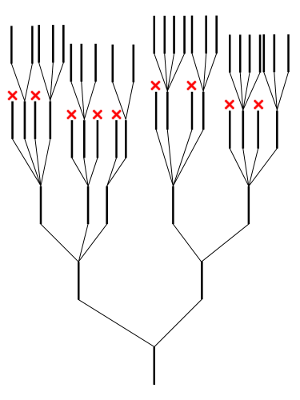
), and taking philosophers like Martin Heidegger as an example. This problem has in fact also already been incorporated into the presented model. Because the two orientations of the abstraction scheme are in fact not each others (vertical) mirror image. The real (vertical) mirror image of the first one looks like shown on the right.
This immediately shows one thing: the levels that are supposed to represent reality are not all on the same height - the same level. This represents, of course, the bias that every individual has.
And a second less obvious problem unless pointed out (here by small red crosses), is the appearance of "spontaneous" levels in the middle of the scheme - levels that have no connection to reality.
This is the symbolic container of the meaningless words of philosophers and all the other verbal garbage that the human mind can and will produce.
Of course it is also the point where one can place things like fantasy and creativity, but fantasy seems to have its major role in dealing with the verbal (and physical) garbage that is produced in such large amounts. A reasonable suggestion is that this is what happens largely at night, in a process called "dreaming".
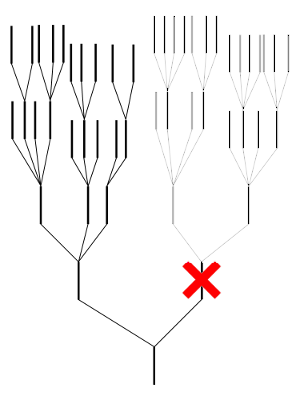 However,
having introduced one "disruption" into the scheme, there immediately rises
the possibility of another: that of one of the levels or paths getting blocked. This is
what Hayakawa describes in a large section of his book as "Two-valued and multi-valued
thinking", or with the words of Karl Popper: "The open and closed mind" (
, chapter 14).
This can readily be introduced into the scheme, see the illustration at the
right.
However,
having introduced one "disruption" into the scheme, there immediately rises
the possibility of another: that of one of the levels or paths getting blocked. This is
what Hayakawa describes in a large section of his book as "Two-valued and multi-valued
thinking", or with the words of Karl Popper: "The open and closed mind" (
, chapter 14).
This can readily be introduced into the scheme, see the illustration at the
right.The causes of such a blockage can also be summarized into one word: "ideology" - the idea that abstractions are more real than the observations of the real world, so one can readily discard some aspects of reality as they present themselves. In practice ideology is usually formulated using "Absolute Truths". Statements that apply "To All Things at All Times". Statements like "All Cultures are Equal", thereby also including the culture of the Nazis of that of the Neanderthals.
In the scheme these statements are identical to the exclusion of levels, for our example: "Unequal cultures do not exist" - such a blockage is represented by a big red cross. And if applied at a low level, it leads to the disappearance of entire branches of reality.
Some of these pitfalls inherent in the abstraction process haven already been incorporated into the earlier given picture of the "inside brain":
|
|
These pitfalls are displayed as:
- the more abstract or bigger cubicles are getting further away from reality.
- the "persons" controlling the concept-cubicles have their heads turned away from reality (as they did before).
-- the number of figures crossing over from reality and towards abstractions is made considerably larger than those going from abstractions back towards reality.
Both Hayakawa and Korzybski describe much more aspects and implications of the abstraction process, but these go beyond this introduction.
 The crucial lesson to be learned from all
the before is of course this: if reasoning or arguments are intended to lead to
something having sense, then always take care that their outcomes says
something about reality. The world outside of the model in your head. This
is the step that breaks the inward spiral that leads to addictions.
The crucial lesson to be learned from all
the before is of course this: if reasoning or arguments are intended to lead to
something having sense, then always take care that their outcomes says
something about reality. The world outside of the model in your head. This
is the step that breaks the inward spiral that leads to addictions. This sounds really simple, but the number of cases that abide by it relative to those that don't, is extremely low - outside of the world of the natural sciences where this step is encoded (
, see the pictures). As an overall guess for all fields outside science and
technology, the
maximum percentage is probably lower than twenty and also probably much
lower. And in all cases where any kind of ideology is involved, and all cases where rhetorical fallacies and similar falsifications of language are used, this percentage tends towards zero with almost the speed of light.
Finally an aspect included much later in the development of this description: the inclusion of emotions. Korzybski doesn't mention their role in any length, but Hayakawa does. But doesn't explicitely mention their most important aspect: their ability to completely override the influence of the rational part of the brain. Where the previous illustrations of the brain do include them, but in a rather defunct way. Because here is the reality:
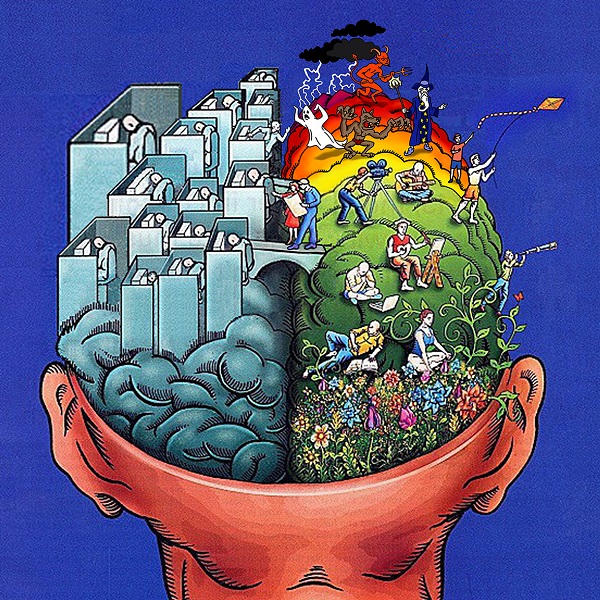 |
These emotions also have a negative side.
And it is this negative side, that hinders the application of the lessons learned in the previous in a fundamental way. For which there seems little remedy.
For more detail on the neurology behind this, see the (earlier mentioned) article on the emotion organs here
- more neurology on the cerebellum here
.
This article is part of the much larger Dutch version
 of this site, that includes more detail on the neurology of things
- perhaps automatic translation is somewhat comprehensible.
of this site, that includes more detail on the neurology of things
- perhaps automatic translation is somewhat comprehensible.